Ground-up construction loans
Permits approved, cash stuck in the land? The loan funds up to 75% of the lot and the entire construction budget, and up to six months of interest can ride inside it.
- 75%
- of the land
- 100%
- of construction
- 85%
- of total project cost
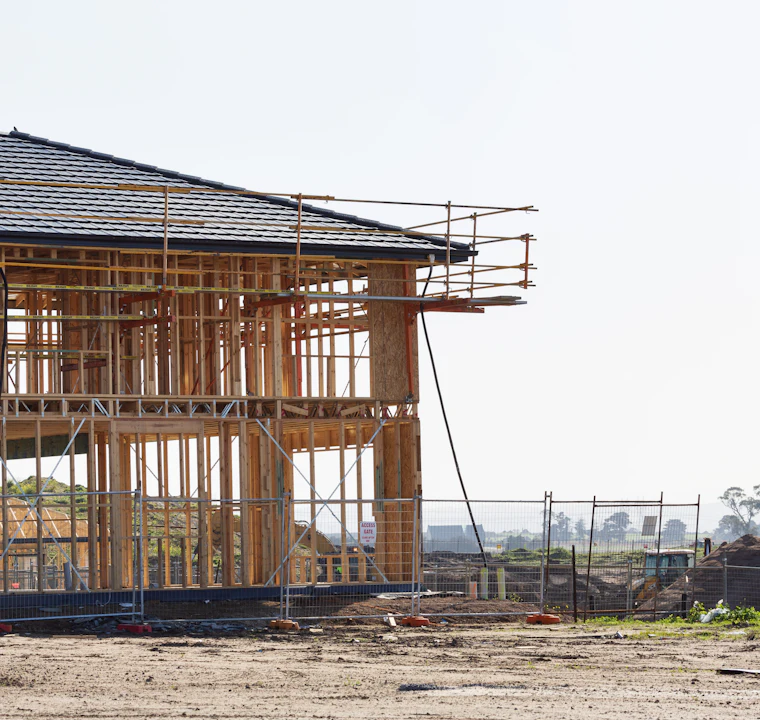 Construction · paid in draws
Typical build
Construction loan terms
Term sheetGuidelines as of November 2026
- Share of the land or purchase price
- Up to 75%. 60% until permits are approved
- Share of the construction budget
- 100%, paid in draws
- Limit against total project cost
- 85%, or 90% when interest is financed
- Limit against completed value
- 70%
- Loan size
- $50,000 to $3,000,000
- Term
- 12 months, interest only. 18–24 months available
- Credit score
- 680 or higher
- Property
- New 1–4 unit homes, up to two per loan
Program maximums for new 1–4 unit residential construction. Not a commitment to lend.
How a ground-up loan is paid out
The land portion is funded at closing. The construction budget is held back and released stage by stage, after an inspector confirms each one. You repay the loan when the homes sell or when you refinance.
Still waiting on permits? The loan can start at 60% of the land and step up to 75% the day the permits are issued.
How much can I borrow to build?
Three limits apply and the lowest one wins. On a $300,000 permitted lot with a $500,000 budget and a $1,250,000 completed value:
| 75% of the land + 100% of construction | $225,000 + $500,000 = $725,000 |
|---|---|
| 85% of the $800,000 total cost | $680,000 |
| 70% of the $1,250,000 completed value | $875,000 |
| Maximum loan, the lowest of the three | $680,000 |
| Funded at closing toward the land | $180,000 |
| Paid in draws for construction | $500,000 |
| Your cash at closing | $120,000 + closing costs and one month of interest |
Illustration only.
Who qualifies
This loan is for builders who have finished ground-up projects. Experience does not change the leverage. It sets the return the project has to show and where you can build. A general contractor’s projects count when the permits were issued to their licensed company.
Swipe sideways to see every column
| Completed builds in 3 years | Leverage | Projected return on your cash | Building in a new market |
|---|---|---|---|
| 1–2 | Land 75%, construction 100%, total cost 85% | 20% or more | Not available |
| 3–4 | Same | 10% or more | With a general contractor agreement, leverage 5% lower |
| 5+ | Same | 10% or more | With a general contractor agreement, leverage 5% lower |
What to have ready
- Plans, elevations and a site plan
- Issued permits, or a letter from your architect while they are pending
- An itemized construction budget and your contract with the builder
- Your list of completed ground-up projects
- Company documents, plus cash for your share, closing costs and one month of interest
What happens after you send a build
- 1
Tell us about the deal
Your contact details and a line about the property. No application at this stage.
- 2
Hear where the deal stands
Which loan fits and how much it covers, before you spend money on an appraisal. If the numbers don’t work, we tell you that too.
- 3
Get written terms
A soft credit check that leaves your score alone, then a term sheet. After you accept it: appraisal, title, insurance and your company documents.
- 4
Close in your LLC
Funds go to escrow at closing. Rehab and construction money comes out in draws as each stage of work is finished.
Construction loan questions
Can the loan close before permits are issued?
Yes. It funds 60% of the land at closing and rises to 75% once the permits are approved.
How much of my own money goes into a build?
Typically 15% of the total project cost, or 10% when interest is financed, plus closing costs.
Can interest be rolled into the loan?
Yes, for up to six months.
What if construction runs past 12 months?
Terms of 18 to 24 months are available, and a term can be extended when the build takes longer.
I flip houses. Does that count as building experience?
No. The program looks for completed ground-up projects. A licensed general contractor’s builds for clients do count.
Can one loan cover a lot split or two houses?
Yes. Two homes can sit in one loan, lot splits included.
Can I refinance land I already own?
Often, yes, including land bought before the permits came through.
How do I get the rehab or construction money?
It is set aside at closing and paid out in draws. You ask for a draw, an inspector confirms the work, and the funds are released.
What if I decide to keep the house as a rental?
Once it is rented, refinance into a 30-year DSCR loan that qualifies on the rent.
Does the loan have to be in an LLC?
Yes, an LLC or a corporation borrows. If you don’t have one yet, you can set it up before closing.
Which states do you lend in?
In 47 states and Washington, DC: everywhere except North Dakota, South Dakota and Vermont. California, Florida and Texas are our main markets. Some programs have their own rules in certain states and counties, and we confirm them when we look at the deal.
Have a deal in hand?
Leave your contact details and a line about the deal. We get back to you with which loan fits, how much it covers and written terms, before you pay for an appraisal.
- No hard credit pull to see terms
- No tax returns or W-2s
- Business-purpose loans on investment property